

 Expert verified
 When you sell a business, in India one of the most important steps is to transfer business licenses during sale.
In this guide, we’ll explore the meaning, types, process, documents, and common mistakes to help you transfer business licenses smoothly.
What Does It Mean to Transfer a Business License?
Transferring a business license means shifting the ownership and operational details of an existing business license from the current licensee to a new party.
This typically is done as part of a business sale, ownership change, or inheritance.
Since most licenses are issued to a specific individual or legal entity, and cannot be directly transferred, the term “transfer” generally means:
- Cancellation or modification of the existing license by the current owner.
- Application for a new license by the incoming owner, supported by sale or transfer documents.
Importance of License Transfer in a Business Sale in India
- Legal Continuity: Licenses like GST, FSSAI, and Shop & Establishment are issued to specific individuals or entities. Without transfer, the new owner cannot operate legally, risking penalties or shutdowns.
- Regulatory Compliance: Indian laws require businesses to hold valid licenses in their legal name and inform authorities of ownership changes. Operating under old licenses can lead to fines or cancellations.
- Liability Protection: Improper license transfer can result in the buyer being liable for past violations or taxes. Similarly, the seller remains exposed if licenses stay in their name.
- Preserving Goodwill & Trust: Updated licenses reinforce trust with customers, vendors, banks, and other stakeholders. They’re also essential for maintaining bank accounts, issuing invoices, and honoring contracts.
- Smooth Due Diligence: Buyers verify license validity and compliance during due diligence. Failure to transfer licenses can delay, reduce, or even terminate a deal. Most agreements include specific license transfer clauses to avoid disputes.
Types of Business Licenses That May Require Transfer During Sale
Here are the most common business licenses in India that may require transfer during a sale or ownership change:
1. GST Registration
Operating without a valid GSTIN in the buyer’s name can lead to tax penalties and ineligibility for input tax credit.
- Transferability: Can be transferred under GST succession rules when a business is sold, merged, or transferred.
- Governing Authority: Central/State GST Department
- How to Transfer:
- Seller files Form GST REG-16 for cancellation citing business transfer.
- Buyer applies for new GST registration on the same premises under GST REG-01.
2. Shop and Establishment License
Mandatory for businesses with physical premises like shops, restaurants, and offices. It ensures compliance with local labour and operating hour regulations.
- Transferability: Generally transferable or amendable
- Governing Authority: State Labour Department or Municipal Corporation
- How to Transfer:
- Notify the authority of the ownership change
- Submit updated documents including the sale agreement, NOC from seller, and identity/address proof.
3. Trade License (Municipal License)
Required for lawful operation of trade, manufacturing, and service businesses within municipal limits.
- Transferability: Transfer allowed in most jurisdictions
- Governing Authority: Local Municipal Corporation
- How to Transfer:
- Apply with the sale deed, previous license copy, and buyer’s KYC.
4. FSSAI License (Food Safety and Standards Authority of India)
FSSAI compliance is mandatory for all food-related businesses like restaurants, catering, packaged food, etc. and enforced through regular inspections.
- Transferability: Not transferable
- Governing Authority: FSSAI
- How to Get:
- In the case of death of the original license holder, legal heirs can apply for transfer within 90 days.
- In most other cases, the buyer must apply for a fresh license.
5. Import Export Code (IEC)
Required for customs clearance and foreign exchange transactions, this license is a must for any entity engaged in international trade of goods or services.
- Transferability: Not transferable
- Governing Authority: DGFT (Directorate General of Foreign Trade)
- How to Apply:
- Buyer applies for a new IEC if there’s a change in business structure or ownership.
6. Pollution Control Board License (CTE & CTO)
Required for manufacturing units, waste-generating industries, and environmentally sensitive businesses. Non-compliance can lead to shutdown orders and penalties.
- Transferability: Transfer allowed with approval
- Governing Authority: State Pollution Control Boards (SPCB)
- How to Transfer:
- File an application with details of the ownership change.
- Provide proof of sale, past compliance reports, and updated infrastructure details.
7. Labour and Welfare Licenses
a. Employees’ Provident Fund (EPF): A mandatory retirement savings scheme where employers and employees contribute monthly; requires new registration by the buyer.
b. Employees’ State Insurance (ESI): Provides medical and cash benefits to employees; buyer must register afresh if employing 10+ workers.
c. Professional Tax Registration (PTRC/PTEC): A state-level tax on professions; transfer rules vary by state—may require new or updated registration.
8. Industry-Specific Licenses
a. Pharmacy License: Required to sell medicines; buyer must obtain a new license under a qualified pharmacist.
b. Liquor License: Needed to sell alcohol; typically non-transferable and buyer must apply afresh with clearances.
c. Health/Nursing Home License:
Authorizes medical establishments; new owners must reapply with updated staff and facility details.
d. SEBI Registration: Mandatory for financial service providers; new firms must register independently with SEBI.
9. Intellectual Property (IP) Rights
Protects brand identity, designs, software, and innovations. It is essential for maintaining trademark rights post-sale.
- Transferability: Transferable via legal agreement
- Governing Authority: Controller General of Patents, Designs & Trademarks
- How to Transfer:
- Execute an Assignment Agreement.
- Record the assignment with the respective IP office.
10. Other Common Licenses
| License Type | Transferability | Remarks |
| Udyam/MSME Registration | ❌ | Reapply in new entity’s name to avail MSME benefits |
| Company Registration (ROC) | ✅ | Can remain unchanged in share sale; new incorporation required in asset sale |
| Gumasta License (Maharashtra) | ✅ | Requires update with Municipal Corporation on ownership change |
| Fire Safety License | ✅/❌ | May require re-inspection based on ownership/premises change |
Types of Business Sales in India & Their Impact on License Transfer
The structure of the business sale affects the transfer of licenses and regulatory approvals in India.
Let’s take a look at the four primary types of business sales in India and their impact on business license transfer:
1. Asset Purchase Sale
In an asset sale, the buyer purchases specific assets of the business (e.g., furniture, equipment, customer database, real estate, or brand name) but not the legal entity itself.
Impact on License Transfer:
| Factor | Impact |
| Legal Entity | Changes (New legal entity operates assets) |
| License Transfer | Not transferable |
| Buyer Must | Apply for fresh licenses under new entity |
| Operational Disruption Risk | High – must wait for new approvals |
| Example: | Buyer purchases a restaurant’s lease and kitchen equipment. Must apply for a new FSSAI license and trade license. |
2. Slump Sale (Business as a Going Concern)
A slump sale involves the sale of an entire business unit “going concern”, assets and liabilities, without individual asset valuation.
Impact on License Transfer:
| Factor | Impact |
| Legal Entity | Changes (Buyer operates through new entity) |
| License Transfer | Possible but not automatic |
| Buyer | May get smoother approvals under “succession” |
| Operational Disruption Risk | Moderate – depends on license type |
| Example | GST registration may be transferred, but a new Drug License or FSSAI License is likely required. |
3. Share Purchase Sale (Stock Sale)
In a share sale, the buyer purchases shares of the company. The company itself remains unchanged and only the ownership changes hands.
Impact on License Transfer:
| Factor | Impact |
| Legal Entity | Unchanged |
| License Transfer | Not required – licenses continue |
| Buyer Must | Notify regulatory bodies of ownership change |
| Operational Disruption Risk | Very low – seamless transition |
| Example | Buyer acquires 100% shares of a company with GST and Pollution Control License, both licenses continue valid. |
4. Sole Proprietorship Sale to Company/Partnership
When a sole proprietor sells the business to a private limited company or partnership, the entity changes completely.
Impact on License Transfer:
| Factor | Impact |
| Legal Entity | Changes (individual → corporate entity) |
| License Transfer | Not allowed – new applications required |
| Buyer Must | Apply for new GST, FSSAI, Shops License |
| Operational Disruption Risk | High – delays until licenses are reissued |
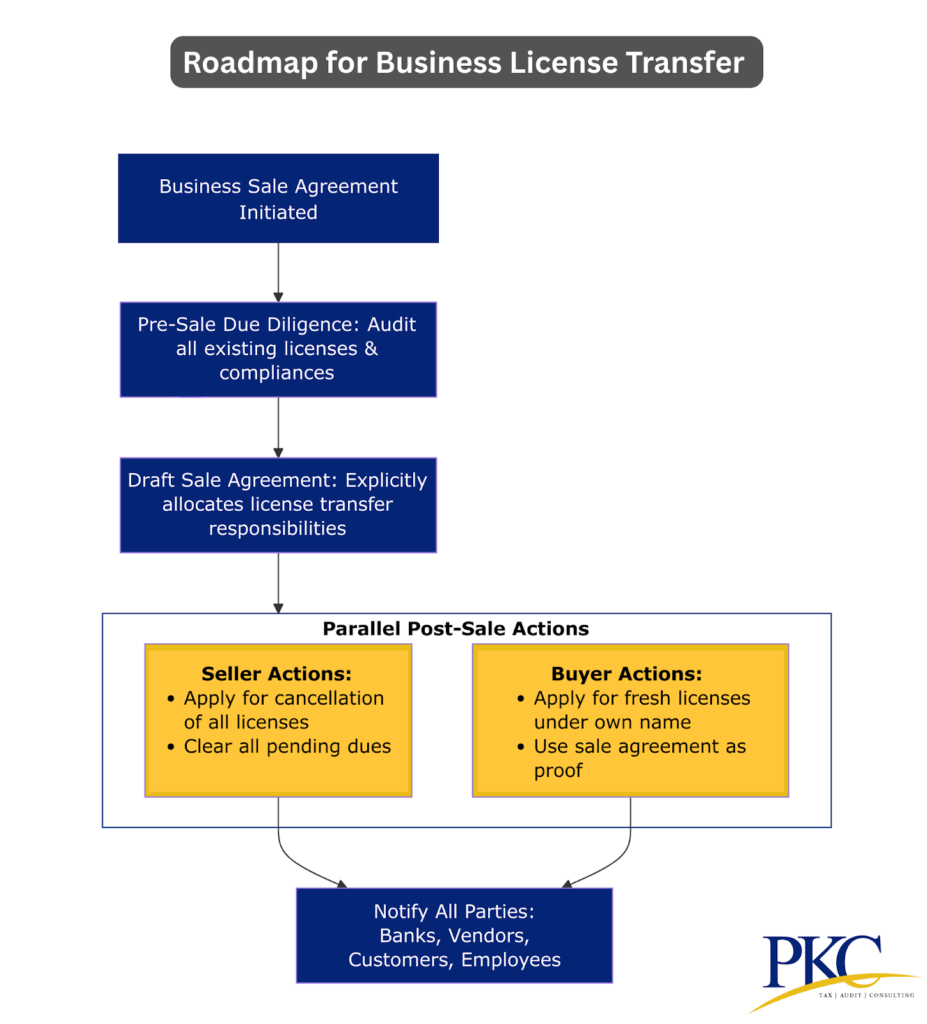
Transfer Business Licenses During Sale: Step-by-Step Process
Let’s understand the process of license transfer during a business sale in India, including legal, regulatory, and practical considerations:
Step 1: Pre-Sale Due Diligence & Planning
Establish clarity on the licenses held, their status, and transferability.
- Seller compiles a list of all existing licenses GST, FSSAI, Shops & Establishments, Trade License, Pollution Control, IEC, Liquor/Pharma licenses, etc.
- Buyer verifies:
- Validity, expiry, and renewal status.
- Whether each license is transferable or needs reapplication
- Any pending penalties, violations, or compliance issues.
Step 2: Draft & Sign a Business Sale Agreement
Legally define how licenses will be handled during the sale.
Agreement should include:
- Type of sale: Share sale, asset sale, or slump sale.
- Schedule of licenses: Attach a detailed list.
- Seller’s obligations:
- Cancel/surrender licenses where needed.
- Clear outstanding dues and obtain NOCs.
- Buyer’s obligations:
- Apply for new licenses where transfer is not possible
- Bear application fees and follow-up responsibilities
- Indemnity clauses for protection against pre-sale regulatory violations.
Step 3: Notify Relevant Licensing Authorities
Legally inform appropriate departments about ownership change or business transfer.
Consult experts from firms like PKC Management Consulting to manage specific cases.
| Authority | License/Action |
| GST Department | File Form REG-16 for transfer/cancellation |
| Municipal Corporation | Transfer or apply for new Trade License |
| Labour Department | Update Shops & Establishments License |
| FSSAI | Apply for a new license (non-transferable) |
| Pollution Control Board | Apply for Consent to Operate transfer |
| DGFT | IEC code updates if entity changes |
Step 4: Submit Required Documents
Provide all documentation necessary for processing the transfer or fresh application including:
- Copy of Business Transfer Agreement or Sale Deed
- Old license copies
- Buyer’s ID/address proof
- Board resolution (if buyer is a company)
- NOC from seller or relevant departments (if required)
- Proof of business continuity (for slump sale transfers)
Step 5: Pay Applicable Fees
Complete the statutory fee payments to validate the transfer or application.
Examples:
- Trade License Transfer Fee (varies by municipality)
- FSSAI new application fee based on turnover
- GST registration is free, but processing may take time
Step 6: Apply for Fresh Licenses Where Needed
Obtain new licenses for non-transferable permits. We have discussed these in the section above.
Start early to avoid gaps in operations.
Step 7: Receive Approvals & Licenses
Obtain updated or fresh licenses in the name of the buyer or new entity. Keep soft and hard copies of all approvals for future audits.
You will receive:
- Amended license with new ownership (if transfer is permitted)
- Fresh license (if not transferable)
Step 8: Update Tax & Regulatory Registrations
Keep compliance aligned with the new ownership.
- GST: New registration or updated authorized signatories
- Income Tax: PAN updates if entity structure changes
- EPF/ESIC: New employer code or change in ownership
- MSME/Udyam: Update registration details
Step 9: Inform Stakeholders & Maintain Records
Ensure a transparent transition and uninterrupted business.
- Notify banks, vendors, employees, and clients about updated licenses and ownership.
- Update invoicing details, contracts, and letterheads.
- Maintain a digital compliance file with:
- Old and new licenses
- Approval letters
- Sale agreement and NOCs
Common Mistakes When Transferring Business Licenses
- Not Checking Which Licenses Are Transferable: Not all licenses can be transferred. Some, like FSSAI or Liquor Licenses, need a fresh application. Failing to apply for the correct licenses could lead to fines or business closure.
- Not Informing Authorities on Time: Failing to notify authorities about ownership changes can result in license cancellation, penalties, or business disruption.
- Overlooking Pending Liabilities: Ignoring unpaid taxes or penalties tied to licenses can create future financial and legal problems for the buyer.
- Confusing Asset Sale with Share Sale: In an asset sale, licenses may need to be reapplied for. Misunderstanding this can lead to delays or additional costs.
- Not Updating Employee-Related Registrations: Forgetting to update labor-related registrations can cause issues with compliance and lead to penalties.
- Failing to Keep Proof of Transfer: Not retaining proof of license transfer can cause disputes or compliance issues down the line.
- Relying Only on Verbal Agreements: Verbal assurances from the seller should be backed by formal documentation. Without it, buyers risk operating without valid licenses.
- Not Budgeting for Transfer Fees: The transfer process can incur additional costs, and not budgeting for them can lead to delays or financial strain.
- Ignoring State-Level Differences: Licensing rules vary by state, and not accounting for these differences can result in delays or penalties.
- Choosing the Wrong License Category: Incorrectly classifying the business can delay the transfer or lead to additional applications.
- Not Seeking Professional Assistance: Handling the transfer without professional help can lead to costly mistakes. Professionals ensure everything is done correctly.
Documents Required to Transfer Business Licenses During Sale – PDF Checklist
When transferring business licenses during a sale, both the seller and buyer must submit a comprehensive set of documents.
Here’s a quick checklist